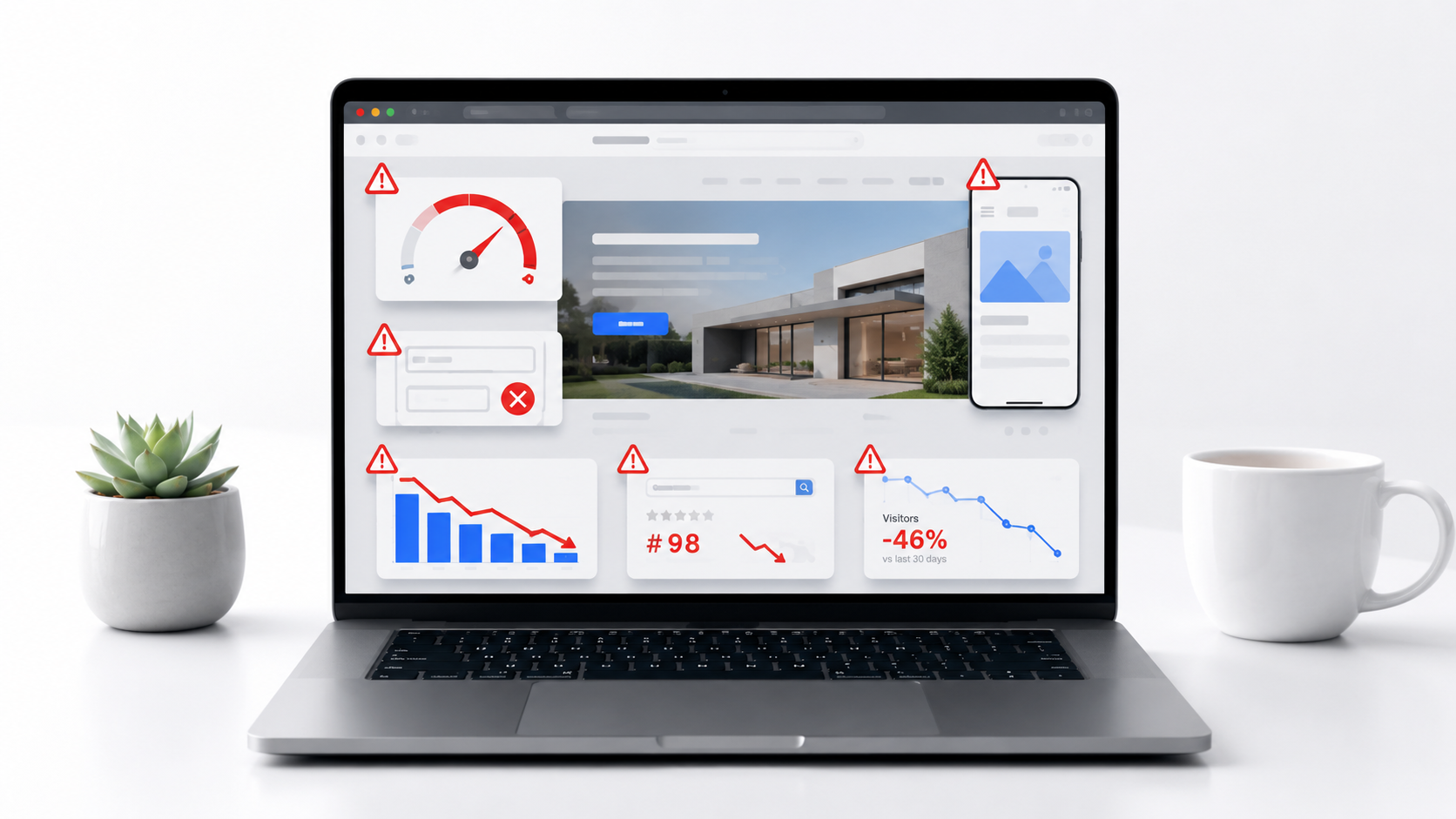
Most business owners on the North Shore do not lose customers because of one big, obvious mistake. They lose them a few at a time, quietly, because their website is working against them and nobody notices. A slow page here, a phone number that is hard to tap there, and over a year that adds up to real money walking out the door.
The tricky part is that an outdated website almost never looks broken to the person who owns it. You know where everything is, so it feels fine. Your customers do not get that head start. Here are seven signs your website is costing you customers, and what each one is actually telling you.
1. It loads slowly on a phone
If your site takes more than about three seconds to load on a cell connection, you are losing people before they ever see what you do. More than half of mobile visitors leave a page that takes too long. Walk down Cabot Street in Beverly or through downtown Salem and nearly everyone looking for a local business is doing it on a phone, often on a spotty signal. A slow site punishes exactly those people, and they rarely come back to try again.
2. It is a chore to use on mobile
Pinch to zoom, buttons too small to tap, text that runs off the edge of the screen. If your site was built before phones took over web traffic, it might still load but be miserable to actually use. Google indexes the mobile version of your site first, so a site that only really works on a desktop is quietly telling search engines it is second rate.
3. Your phone number is not one tap away
For a local business, the phone call is often the whole point. If a visitor has to hunt for your number, copy it, and paste it into their dialer, many will simply give up and call the next result. Your number should sit at the top of the page as a button that dials the moment someone taps it, on every single page.
4. The content has not changed in years
Old hours, a staff member who left in 2021, prices that are no longer real, a copyright date that ends a few years ago. Stale content does two things at once. It gives customers wrong information, and it signals to Google that the site is neglected. Both cost you. A site that looks tended to earns more trust before a single word is read.
5. You do not show up for your service plus your town
Search "plumber Peabody," "hair salon Marblehead," or "auto repair Danvers" and see whether you appear. If you are nowhere on the first page for the exact thing you sell in the town you sell it in, that is not bad luck. It usually means the site is missing the local signals search engines look for, and every one of those searches is a ready-to-buy customer landing on a competitor instead.
6. Nobody can update it, including you
Maybe the person who built it disappeared. Maybe it is on a platform you never got the login for. If a simple change like a new phone number or a holiday closure turns into a week-long project, the site is a liability, not an asset. You should be able to get a small change made the same day, without a scavenger hunt.
7. Nothing tells the visitor what to do next
A visitor lands, reads a little, and then what? If there is no clear next step, most people leave. Every page needs one obvious action: call now, book a consultation, get a quote. When the path forward is obvious, more visitors take it. When it is not, they close the tab and you never know they were there.
What to do about it
If you recognized your own site in three or more of these, it is not an emergency, but it is a leak worth plugging. Start by figuring out where visitors are dropping off. We wrote a fuller breakdown of the most common reasons a site stops turning visitors into calls in why your website isn't getting leads, and it is a good next read.
If you would rather have someone just handle it, that is what we do for small businesses across the North Shore. Book a call and we will tell you straight whether your current site is worth keeping or whether you are better off rebuilding. No long-term contracts, no jargon.